
Healthy eating often comes down to ordinary questions. Is bread enough for breakfast? If lunch already has rice and meat, what would improve it? And how should we read the meat, dairy and butter in the new US guidance?
We read the Chinese Nutrition Society’s guidance alongside the official US text. Both can help with meals, but they address different populations and eating habits. For a household eating a Chinese-style diet, China’s guidance is a practical starting point; the US edition adds another perspective.
China’s current general guidelines remain the 2022 edition. The US edition covers 2025–2030 and was published in January 2026. Start by knowing which edition and population you are reading, rather than trying to memorize every number.
Start with what is missing from a meal
China’s guidance puts food variety near the beginning. Look at meals you eat repeatedly. Rice or bread and meat may be easy to find. Do vegetables have enough space? Do fruit, dairy and soy foods regularly appear across the day? Start with a category you often miss.
If breakfast is usually just bread or a steamed bun, consider an egg and some dairy or soy food, according to your preferences and tolerance. When ordering lunch, check whether the vegetables amount to little more than garnish; an extra vegetable dish may help. Rotate fish, poultry, eggs, lean meat and soy foods. These are ways to plan meals; amounts still depend on age, activity and health.
The Chinese Nutrition Society’s official food pagoda and plate show the bigger picture. The pagoda describes the daily food pattern; the plate helps visualize a meal. Read the quantities and notes beside the illustrations as well as the shapes.
Portions describe a day, and the weight needs a definition
China recommends at least 300 g of vegetables daily, about half dark-colored, and 200–350 g of fresh fruit. Juice does not replace whole fruit. Dairy intake should reach the equivalent of at least 300 ml of liquid milk a day. These foods can be spread across meals.
Grains need particular care. The daily range is 200–300 g, including 50–150 g of whole grains and mixed beans, plus a separate 50–100 g of tubers. The grain amounts refer to uncooked weight. Rice absorbs water during cooking, so a bowl of cooked rice cannot be weighed against that range directly. Gradually mix suitable whole grains and beans into white rice, and include tubers in your staple-food planning.
The CNS explanations of food variety and vegetables, fruit and dairy give the context. Appetite, activity and life stage affect needs; a general adult range is not a fixed menu for everyone.
Salt and oil include what is already in the food
China advises adults to keep salt at no more than 5 g a day and cooking oil at 25–30 g. Salt in soy sauce, dressings, preserved foods and takeout counts too. After eating these foods, 5 g is not an extra allowance for the kitchen.
Try one change at a meal. Ask for sauce separately, avoid stacking several salty seasonings, or replace a sugary drink with water or an unsweetened drink. Choose a step you can repeat. The CNS salt and oil guidance explains the limits.
Read the new US pyramid with the text beside it
The US edition emphasizes nutrient-dense, less-processed foods and reducing highly processed foods. Its official cover groups protein foods, dairy, vegetables, fruit and whole grains. The illustration introduces food categories; the text explains how to use them.
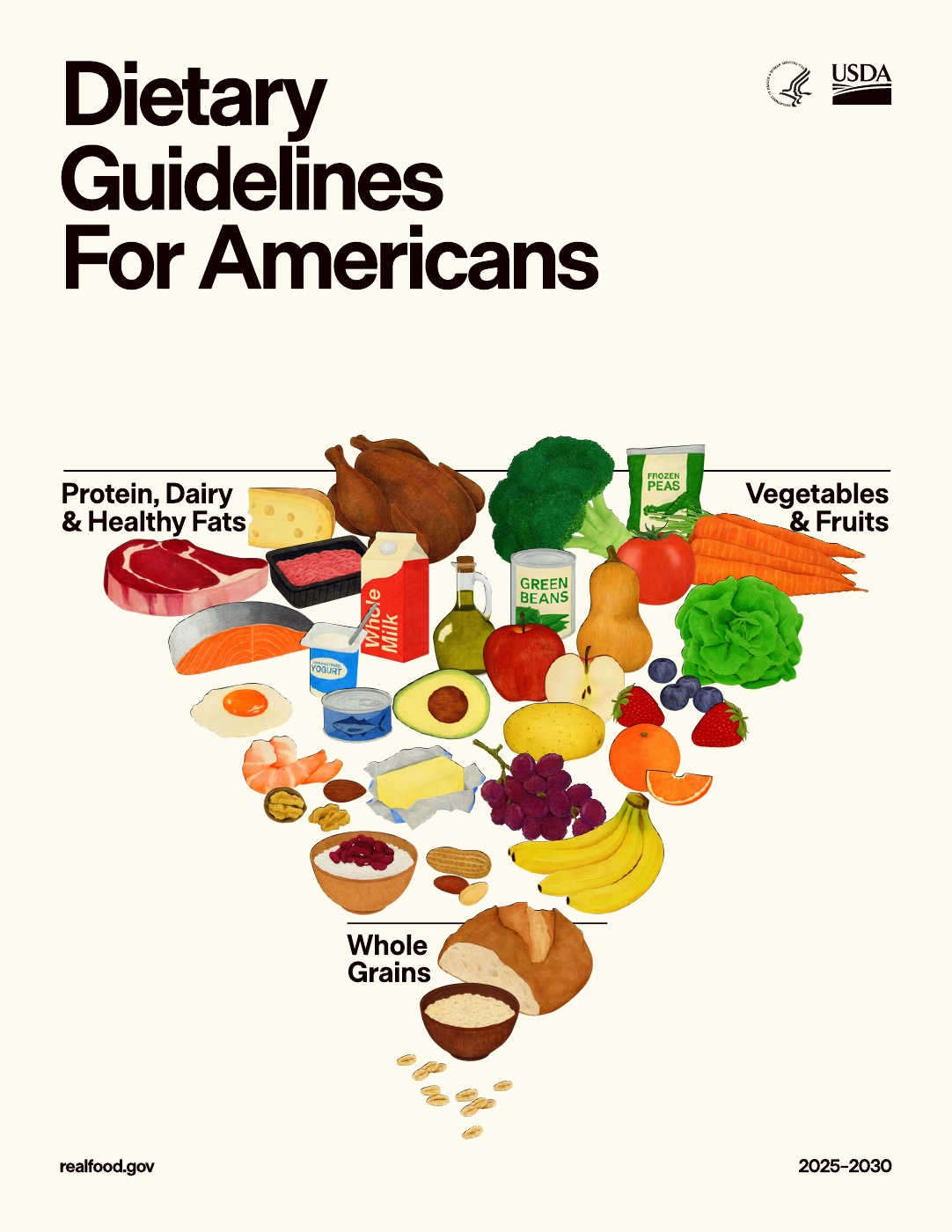
Official guideline cover, US Departments of Health and Human Services and Agriculture. Open the image to read the English original.
Its protein target is 1.2–1.6 g per kilogram of body weight daily, adjusted for individual calorie needs. For 60 kg, the arithmetic gives 72–96 g of protein. Protein is a nutrient within food: that number is not the weight of meat, and does not itself mean you need to increase your intake.
The guidance includes unsweetened full-fat dairy and mentions butter and beef tallow as cooking-fat options. It also retains a general saturated-fat limit of 10% of daily calories. A food being an option still calls for considering the whole day’s intake.
Before counting US servings, check the serving guide
For a 2,000-calorie pattern, the text lists 3 vegetable servings, 2 fruit servings and 3 dairy servings; whole grains have a daily target of 2–4 servings. A serving is defined by food group, and targets change with calorie needs.
This complete page from the official companion guide shows calorie levels across the top, with food groups and serving examples on the left. On a phone, open the original PDF to zoom in.
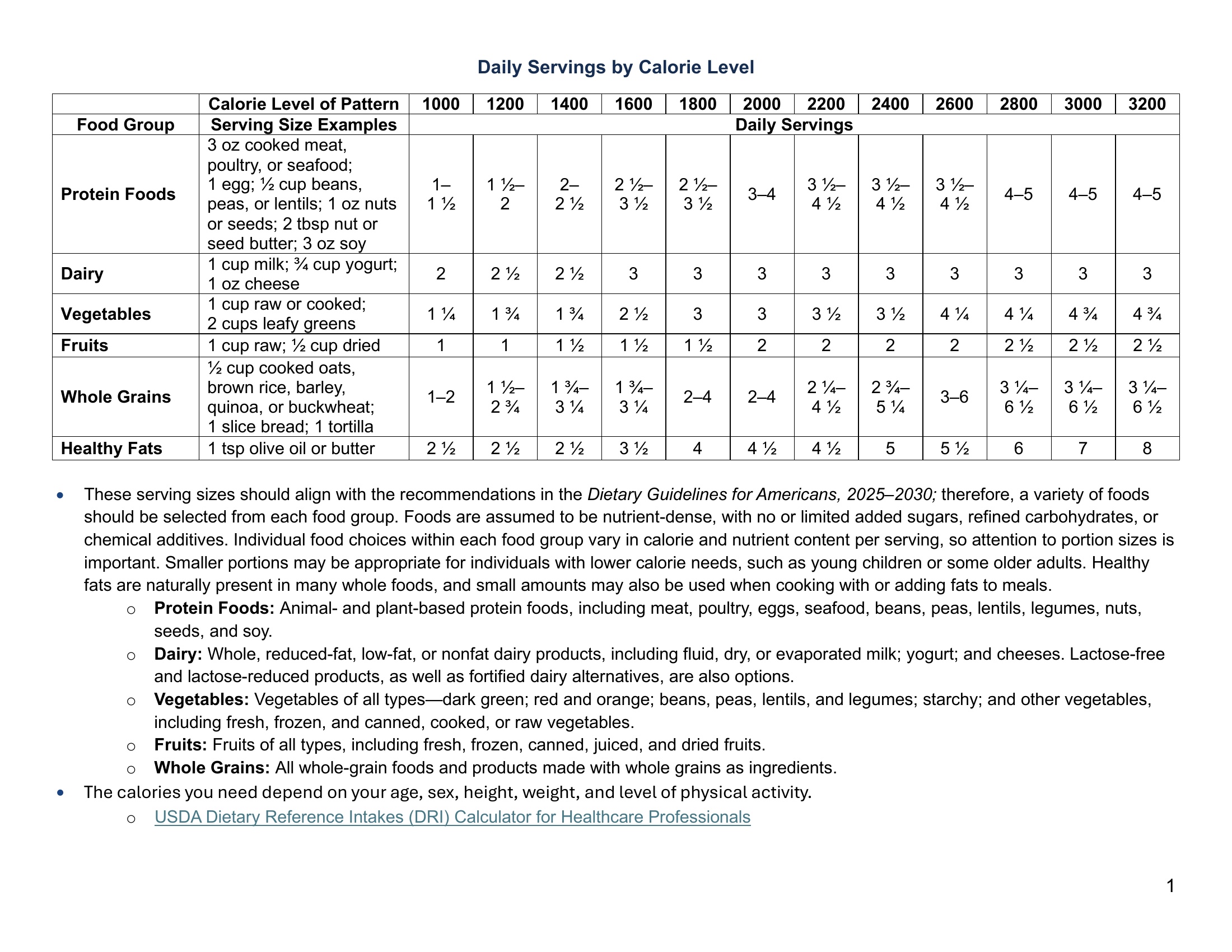
Complete table page from the official Daily Servings by Calorie Level guide.
Units also matter when comparing countries. The US text recommends less than 2,300 mg of sodium daily for ages 14 and older. China’s 5 g refers to salt. Sodium and salt are different measures, and children have age-specific recommendations.
Choose one change for the next meal
If vegetables are often missing, make room for them next time. If drinks usually contain sugar, try water. Once that becomes routine, look at fruit, dairy, soy foods and whole grains. Reviewing a week of meals makes recurring gaps easier to see than judging one meal in isolation.
Children, pregnancy, breastfeeding and older age have their own guidance. Kidney disease, food allergies, swallowing difficulties and other dietary restrictions call for advice from a clinician or registered dietitian; do not directly adopt the protein calculation above.
Below, signed-in readers can download the official US English PDF, our independent complete Chinese translation, and a Chinese-guideline reader PDF. The complete Chinese book is available through the CNS official entry. Our US Chinese translation is clearly labeled unofficial. Continue with the source materials here.
Originals, translations and further reading
- Official Chinese Dietary Guidelines (2022) website
- Official English PDF of the US 2025–2030 guidelines
- Official US daily servings and supporting reports
- Online Traditional Chinese translation for reference—not an official US government edition
- Vietnamese translation · Vietnam National Institute of Nutrition (not a US official translation)
- Japanese translation · Japan Holistic Nutrition Association (not a US official translation)
- Back to the chapter on diet and health
Edition checked: 2026-11-04. This article was independently prepared by our site. It retains the original guidelines’ issuing bodies, years and links. Third-party translations are provided as further reading; if the meaning is unclear, refer to the official English original.